Mitra
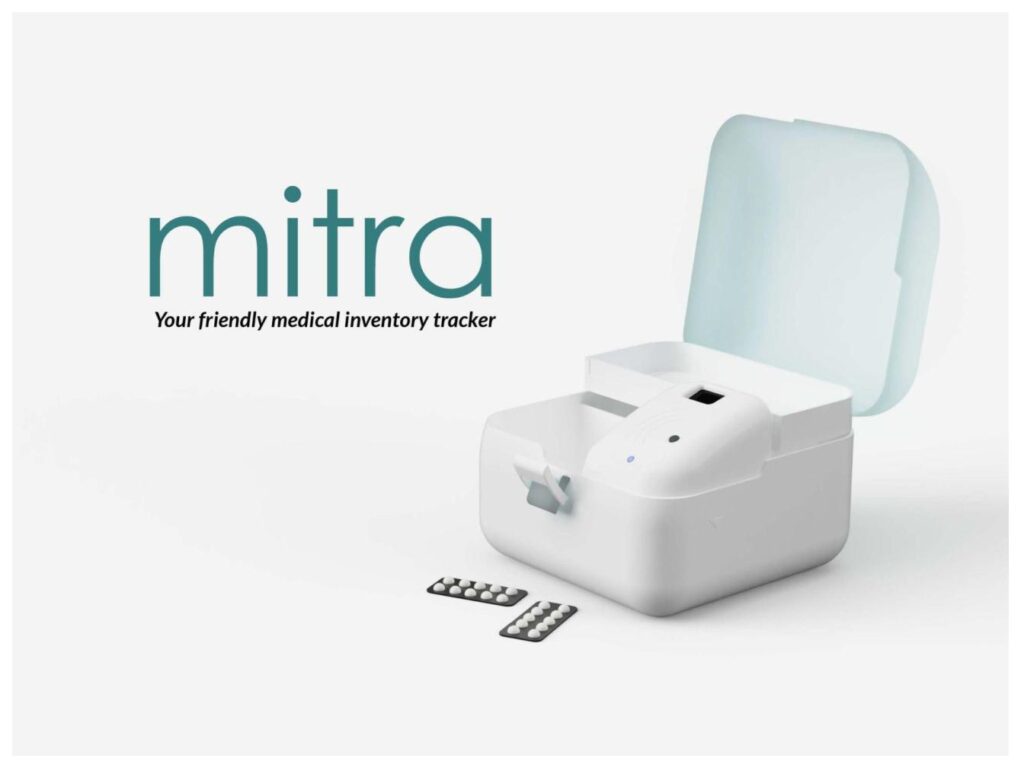
designs Mitra Your Friendly Medical Inventory Tracker This project was the outcome of an intensive 8-week design exercise undertaken during the 5th semester of industrial design. The objective was to develop a technically complex product that provides an IoT-based solution to a real-world problem, adhering closely to the structured design process. The Concept Infographic Background The problem arose from a common scenario in student housing communities, where individuals with sudden ailments often sought SOS medication from friends. This interaction typically involved three personas:(i) the person in need,(ii) the helper,(iii) and the one possessing the required medication. The aim was to streamline and facilitate this connection between those in need and those who could assist. Problem Statement During medical emergencies, many people struggle to find non-prescription SOS medications at hand. A user survey conducted across various age groups, lifestyles, and living situations in India revealed that while most individuals diligently refilled prescription medications, general pills for ailments like cold, cough, or nausea were often neglected. Statistics indicated that 40% of the general population faced this issue, with the percentage rising to over 70% among students. Target User Key challenges identified from the survey and focus interviews included: • Location: Living on city outskirts or in areas with poor connectivity and limited access to 24-hour pharmacies. • Limited Mobility: Lack of personal transportation and restricted access to public transport during odd hours. • Unfamiliar Environment: Being in a new place, unfamiliar with the area, local language, or support systems, adding to the difficulty of accessing essential resources. Design Brief “How might we design an IoT-enabled medical box that ensures the user has stock of non-prescription SOS medication whenever needed” Concept Proposed The solution could offer a 3-point intervention: Block Diagram A working proof of concept (POC) was developedfrom the circuit to the coding to validate the intended technology: • Cloud Database: Built on Google Sheets. • App Prototype: Developed using MIT App Inventor. • Medicine Box Electronics: Arduino-driven RFID circuit. • Box-to-Cloud Connectivity: Established via Wi-Fi, coded with Arduino CCE. • Cloud-to-App Connectivity: Enabled through Google Scripts. • Box-to-App Connectivity: Interconnected via the cloud, coded using HTML. Mood Board The design was guided by a mood board featuring light pastels and soft, rounded forms to evoke a sense of comfort and reassurance.The form ideation prioritized friendly aesthetics, avoiding sharp edges, while accommodating manufacturing constraints and electronic requirements Form Ideation While ideating the form, soft curves with fillets and rounded edges were chosen to ensure a friendly and approachable design.However, manufacturing constraints and electronic integration requirements were carefully considered throughout the process. Final Concept The concept featured a layered medicine boxwith ample storage, a translucent lid secured by asafety latch, and an OLED screen for display,angled for easy readability. An RFID scanner was positioned on the bottomleft, angled for accessibility, while a slide-in coverhoused the AA battery case. RFID-chip clip-onswere provided to attach to pill strips, ensuringeasy identification Detailing The box was designed for injection moulding, with cloudy ABS for the body and translucent ABS for the lid. The PCB was also designed on Autodesk Eagle and fabricated by hand to fit within the available space. For prototyping, an ESP-32 module enabled Wi-Fi connectivity, though it could be converted into an IC (integrated circuit) for a commercial product, saving space and simplifying assembly. Electronic Packaging While ideating the form, soft curves with fillets and rounded edges were chosen to ensure a friendly and approachable design.However, manufacturing constraints and electronic integration requirements were carefully considered throughout the process. Prototyping The POC was initially built on a circuit board and later refined into a handmade PCB, fitted into a 3D-printed chassis for testing. The functional prototype demonstrated the feasibility of the design. Conclusion The product, named Mitra (meaning “friend” in Sanskrit), was well-received by the jury. Several use cases resonated with them, and one senior jury member noted that the product has strong potential in the market if pursued commercially. The product owner remains open to collaboration and productisation opportunities. The animated motion graphic was made to present the complete concept. https://meraki-ahona.in/wp-content/uploads/2025/05/1.2_-Mitra-_-Product-Pitch-Motion-Graphics_D2_2025_202_004.mp4